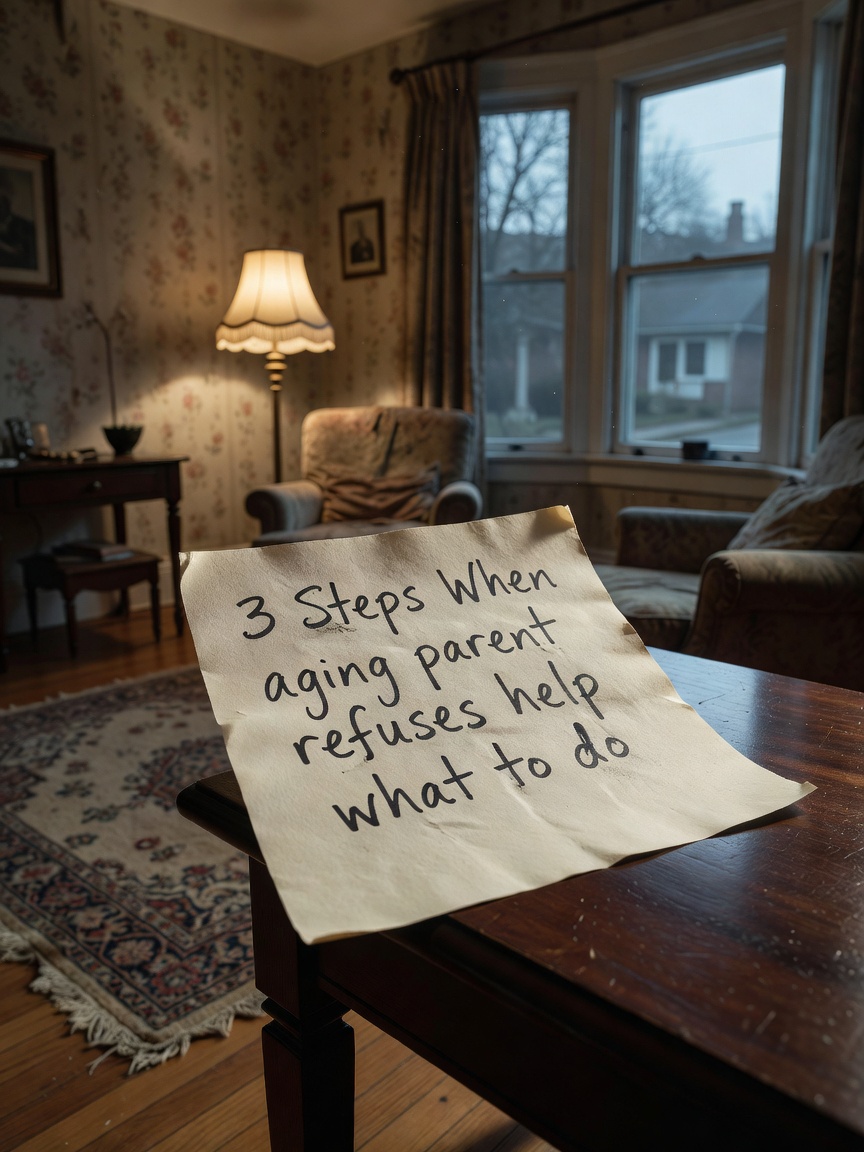
When an aging parent's refusal of help creates a safety risk, empathetic communication may not be enough. This guide provides a crisis intervention plan, including how to document risks, engage professional services, and understand legal options. A private family network like Kinnect can help coordinate these complex efforts and preserve family stories during this stressful time.
Navigating an aging parent's refusal to accept help involves assessing safety risks, documenting specific incidents, and potentially engaging outside professionals when their well-being is compromised. This process moves beyond persuasion to structured intervention, focusing on objective needs rather than subjective arguments to ensure their safety and support.
Kinnect is now LIVE! Start your private family group today.
👉 Try Kinnect on the Web
👉 Download the iOS App
I remember sitting at my dad's kitchen table, looking at a pile of unopened mail and a refrigerator with more condiments than food. He insisted he was fine. Perfectly fine. But I could see the tremor in his hand, the confusion that flickered in his eyes. Every conversation we had about getting a little help ended in a slammed door. If you're reading this, you probably know that feeling—the knot in your stomach when love and fear get tangled together. You've tried talking. You've tried being gentle. This guide isn't about that. This is for when the conversation has failed, and their safety is now the only thing that matters.
The Turning Point: When Concern Becomes a Crisis
There's a line between a parent valuing their independence and being in active danger. Your job is to see that line clearly, even if they can't. A crisis isn't just one big event; it’s often a series of small, alarming signals. Are they forgetting to take vital medications? Have there been unexplained bruises from falls? Is food spoiling in the fridge? Are they getting lost on familiar routes? These are not moments for debate; they are data points indicating that the situation has become unsafe. Recognizing this shift is the first, hardest step. It’s the moment you have to accept that their right to independence can't override their right to be safe.
Step 1: Become an Objective Reporter
Your feelings of frustration are valid, but they aren't evidence. To get your parent the right help, you need to move from worried child to objective reporter. Start a simple log in a notebook or a private document. Write down dates, times, and specific, factual observations. For example:
- “Oct 15, 2:00 PM: Found stove burner left on. Mom was in the other room and didn't remember turning it on.”
- “Oct 17, 9:00 AM: Dad missed his cardiology appointment. Said he forgot what day it was.”
- “Oct 19, 6:00 PM: Found expired milk from three weeks ago in the fridge. Dad insisted he just bought it.”
This log isn't about building a case against them. It's about creating a clear, undeniable picture for doctors, social workers, or other family members. It helps you track their ability to manage Activities of Daily Living (ADLs) and shows patterns that a single conversation can't convey.
Step 2: Assemble Your Professional Team
You cannot and should not do this alone. Once you have documented a clear safety risk, it’s time to bring in professionals who are trained for these exact situations. They can act as neutral, authoritative third parties.
Engaging Adult Protective Services (APS)
The name sounds intimidating, but think of Adult Protective Services (APS) as a resource, not a punishment. They are the social services equivalent of paramedics. You can make a confidential call to your local APS agency to report concerns of self-neglect. An agent will typically conduct a home visit to assess the situation. Their goal isn't to take your parent away; it's to evaluate their safety and connect them with local resources like meal delivery, in-home care, or case management. Your log will be invaluable in this conversation.
Hiring a Geriatric Care Manager
If you have the resources, a geriatric care manager (often a licensed social worker or nurse) can be a lifesaver. They are professional problem-solvers for aging. They can perform a comprehensive assessment of your parent's needs, mediate difficult family conversations, and navigate the complex web of healthcare and home care options. They become the project manager for your parent's well-being, which is especially critical if you live far away. Approximately 40% of family caregivers report high emotional stress, and a care manager can lift a significant portion of that burden.
Navigating Legal Tools and Protecting What Matters Most
Step 3: Understanding Legal Options as a Last Resort
Sometimes, if a parent lacks the mental capacity to make safe decisions, you may need to explore legal avenues. This is the final safety net. It's a path to take with heavy consideration and always under the guidance of a professional. Before you do anything, consult an elder law attorney who specializes in these sensitive matters. They can explain the options in your state, which typically include:
- Power of Attorney (POA): This is a legal document your parent signs when they *still have* mental capacity, giving a trusted person (the agent) the power to make financial or healthcare decisions on their behalf. A durable POA remains in effect even if they become incapacitated.
- Guardianship/Conservatorship: This is a court-ordered process used when someone *no longer has* the capacity to make their own decisions and has not designated a POA. A judge appoints a guardian to manage their personal, financial, and medical affairs. It is a significant step that removes an individual's rights, so it is only considered when all other options have been exhausted.
The Hidden Variable: The Fear of Being Erased
We often assume that a parent’s refusal is purely about losing independence. But beneath that is a deeper, more profound fear: the fear of their story being lost. They aren't just clinging to a house; they're clinging to the life they built there, the memories in every room, the identity they've known for 80 years. When we focus only on their physical safety, we can accidentally signal that their legacy—their personhood—no longer matters. Our own research highlights a tragic 'Legacy Preservation Gap': 85% of Gen X adults report they wish they had recorded their parents' voices before they passed, yet only 12% have a system for doing so. This crisis isn't just about managing their decline; it's our last chance to honor their life.
While you navigate the difficult logistics of care, it's essential to create a space that honors their story. This is where the hard work of caregiving can coexist with the heart work of connection. It’s about making sure the person doesn't get lost inside the patient.
Kinnect was built for this very reason. It’s a private, secure space where your family can coordinate care updates without the noise of a chaotic group text. More importantly, it’s a place to preserve your parent's legacy. You can use our 'Echo' feature to capture them telling a favorite story in their own voice, or scan and share old family photos that spark joy and conversation. In the middle of a crisis, holding onto who they are—and who you are as a family—is the most important work of all.
What to Do When an Aging Parent Refuses Help: FAQ
How do you help an elderly parent when they don't want help?
Start by objectively documenting specific safety concerns instead of arguing. Engage a neutral third party, like a geriatric care manager or their primary doctor, to assess the situation and mediate a conversation. This shifts the focus from a family conflict to a health and safety plan.
What to do when an elderly parent refuses to move?
First, explore all options for bringing support into their current home, such as in-home care or meal services. If the home itself is unsafe, an assessment from an occupational therapist can provide an objective report with concrete recommendations, which can be more persuasive than a family member's plea.
Why is my elderly parent in denial?
Denial in aging parents is often a protective shield against the profound fear of losing their independence, identity, and control. It's less about the facts of their situation and more about the terror of what those facts represent. Acknowledging their fears can sometimes be more effective than confronting them with a list of problems.
What is the best approach for a parent with dementia who refuses help?
When a parent has dementia, their refusal is often part of the disease, and logical reasoning will not work. Focus on creating calm, predictable routines, using redirection instead of arguing, and ensuring their environment is safe. Consult their neurologist or geriatrician immediately, as this is a medical issue requiring a specialized care strategy.
Learn more at Kinnect.
