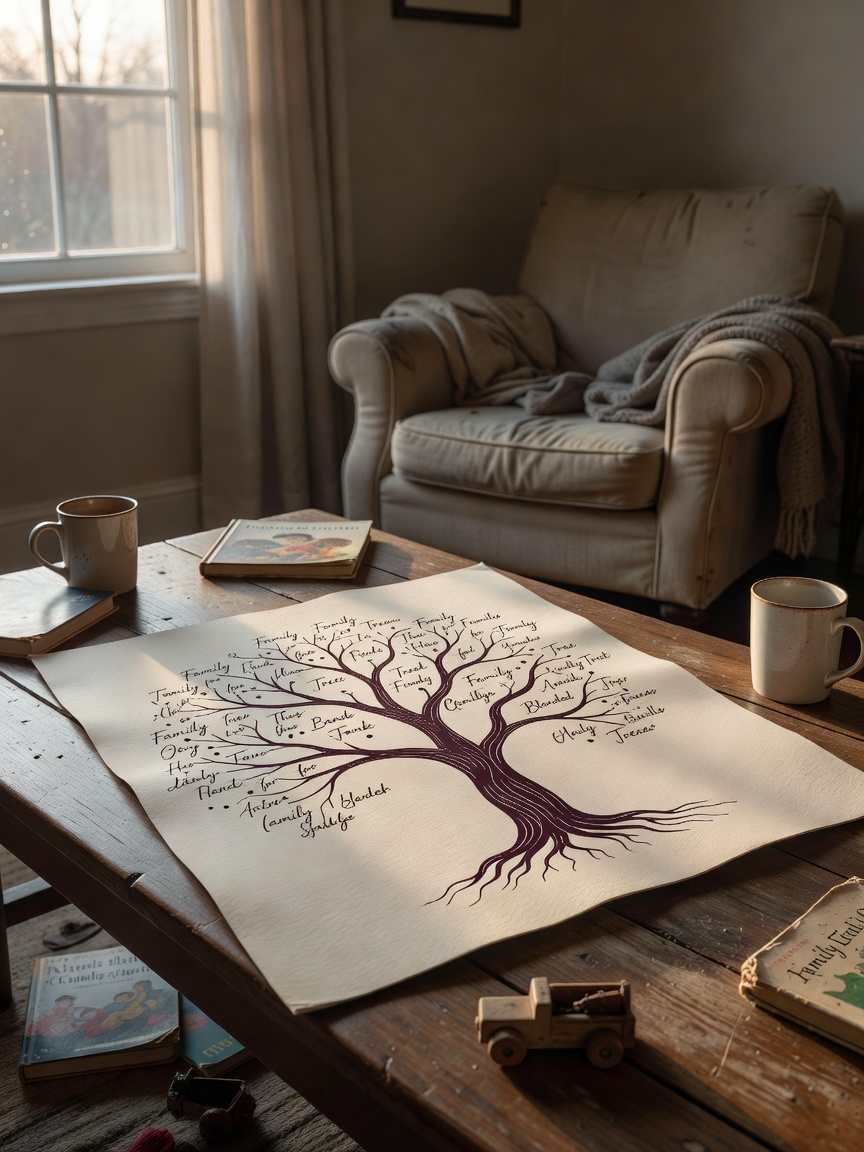
This guide provides a step-by-step process for creating an inclusive family tree with children in blended families, focusing on it as a collaborative project. It offers creative visualization ideas and conversation starters, while a platform like Kinnect can permanently save these stories and connections in a private, digital space.
A blended family tree is a visual representation of a family structure that includes stepparents, stepsiblings, and half-siblings. Unlike traditional genealogical charts focused on bloodlines, it emphasizes relationships of love, care, and choice, providing an inclusive map of a child's complete support system and celebrating the unique bonds that define it.
Kinnect is now LIVE! Start your private family group today.
👉 Try Kinnect on the Web
👉 Download the iOS App
I remember the hollow feeling when my nephew brought home a school assignment: a family tree worksheet. The neat little boxes branching up from 'Mother' and 'Father' didn't have space for his stepdad, the man who taught him to ride a bike, or his stepsister, who was his best friend. His beautiful, loving, complex family looked like a mistake on that piece of paper. It wasn't. The paper was the mistake.
That school worksheet is designed for a family structure that, for many of us, is an outdated photograph. For a blended family, it can feel like a test you’re doomed to fail. But what if we saw it as an invitation? An opportunity not just to fill in boxes, but to tell your child’s unique story, together. This isn't just about getting a good grade; it’s about showing your child that their family, exactly as it is, is whole, strong, and worthy of being celebrated.
Step 1: The Conversation Before the Crafting
Before you get out the glue sticks and poster board, the most important step is to talk. This isn't a lecture, but a shared moment of discovery. The goal is to frame your family’s story as a positive one of growth and added love.
For younger kids (ages 4-7): Keep it simple and concrete. You could say something like, "Isn't it cool how families can grow in different ways? Some families get bigger when a mommy and daddy add new people to love. Our family got bigger when joined us, and we are so lucky! Let’s make a map of everyone who loves you."
For older kids (ages 8+): They'll have more complex questions and feelings. Acknowledge the reality of the situation. Try, "I know that family tree project from school looks confusing because our family is different from the example. That's because our story is more interesting. A family isn’t just about who you’re related to by blood; it’s about who shows up for you. Who should we make sure we include in our family's story?"
Step 2: The 'Family Council' Planning Phase
Turn the decision-making over to them. This is the single most powerful way to give your child a sense of ownership and control over their own story. Sit down with a blank piece of paper and call a 'Family Council' meeting.
Ask the core question: "Who is in our family?" Let your child lead. They might list grandparents, step-grandparents, aunts, uncles, cousins, stepsiblings, and even close family friends or a beloved godparent. Write every name down without judgment. This brainstorming session transforms the project from a rigid assignment into a map of your child’s heart. It reinforces that your family is defined by love and connection, not just by biological lines on a chart.
3 Creative Ways to Build Your Family Tree, Together
Once you have your list of names, it's time to bring it to life. Ditch the traditional tree trunk and branches for something that truly reflects your unique structure. Here are a few ideas to get you started.
1. The Family Constellation
Get a piece of dark blue or black poster board and some star stickers or glitter glue pens. Put your child's name right in the center. Then, create a 'star' for each family member, arranging them in clusters around the child. You can use lines of yarn or silver pen to connect the stars, showing how everyone is connected to the child and to each other. This visually represents the child as the center of their universe, surrounded by a galaxy of love.
2. The Family Garden
This is a wonderful, vibrant option. Cut out a large flower pot shape from brown paper and label it with your family's last name(s). Then, cut out individual flowers or leaves from different colored construction paper. Each person gets their own flower. You can have different colors for different sides of the family or just let your child pick their favorite color for each person. Glue them all 'growing' out of the pot. This shows the family as something living and blooming together.
3. The Digital Storybook
For the tech-savvy family, use a simple presentation tool like Google Slides or Canva. Each person gets their own slide with a photo and a few bullet points your child dictates about them. ("Grandma makes the best cookies," "Mike is my stepdad and he tells funny jokes.") You can then link the slides together. This becomes a living document you can add to over time, and it focuses on the *relationship* and the memories, not just the name.
The Hidden Variable: It’s Not About the Tree, It’s About the Storytelling
The magic of this project isn't the final poster that hangs on the fridge. It's the conversation that happens while you're making it. As you write each name, you’re unlocking stories. You’re talking about why Grandma is special, remembering a funny vacation with an uncle, or explaining how a stepparent came into your lives. Research from Emory University found that children who score in the top third on family story knowledge show up to 3x higher resilience and self-esteem scores. You’re not just making a craft; you’re building a stronger, more resilient child by rooting them in their own history.
This project creates a beautiful snapshot, but these stories deserve more than a piece of poster board. They are the foundation of your family's legacy. What happens when the paper fades or gets put in a box? Ensuring these connections and stories are saved permanently is the next, most crucial step.
This is why we built Kinnect. It’s a private, permanent home for your family’s story, designed for how families actually live today. You can build a visual family map, save voice recordings of your parents telling stories, and share photos in a space that’s completely safe from the data mining of public social networks. Because your family’s story is the most important thing you have, and it deserves a home built to protect it for generations.
Why are traditional family trees hard for blended families?
Traditional family trees use a rigid, biological structure that only accounts for birth parents. This can make children in blended families feel like their family is incorrect or that important people, like stepparents and stepsiblings, don't belong.
How do you explain a blended family to a child?
Explain it in simple, positive terms focused on love. You can say that families sometimes change and grow, and that a blended family means you have even more people to love and support you. Emphasize that all the people in their life make up their unique and special family.
What is the best way to visualize a blended family tree?
The best way is to create a visual that focuses on connection, not just biology. Ideas like a 'family constellation' with the child at the center, or a 'family garden' where everyone grows together, are more inclusive and celebratory than a traditional tree chart.
How do you make a family tree with stepparents?
Include stepparents by placing them alongside the parent they are married to, connected by a line representing their relationship. Most importantly, let your child help decide where they go, focusing on representing the loving and active role they play in the family's daily life.
Learn more at Kinnect.

