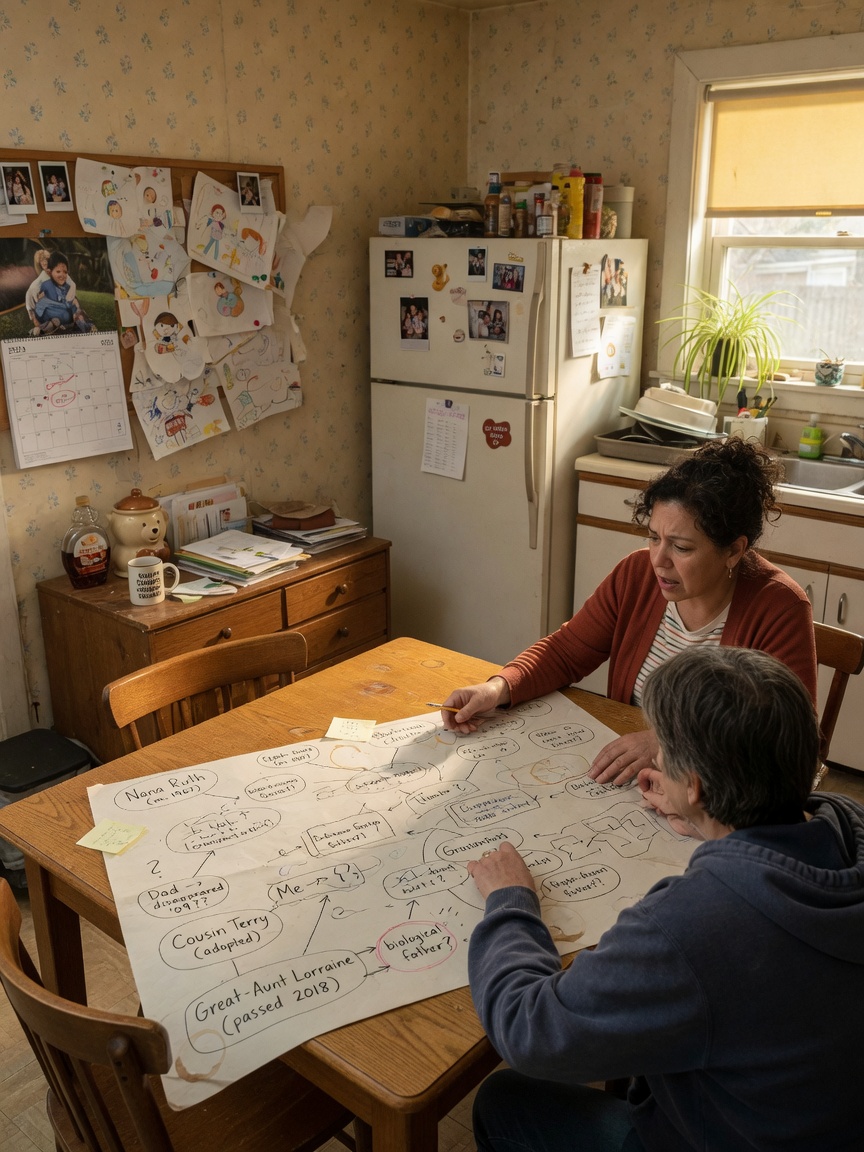
A relationship map is a visual diagram that illustrates the emotional connections, influences, and significant bonds within a family, including non-biological members. Unlike a traditional family tree, it focuses on the quality of relationships, which can be privately documented and shared within a secure space like Kinnect to preserve the full family story.
A relationship map is a visual diagram that goes beyond a traditional family tree by illustrating the emotional quality and nature of connections between people. Instead of focusing solely on genetic lineage or legal ties, it uses different colors, lines, and symbols to represent bonds like mentorship, close friendship, or estrangement.
Kinnect is now LIVE! Start your private family group today.
👉 Try Kinnect on the Web
👉 Download the iOS App
I remember sitting with my dad a few years before he passed, trying to fill out a standard family tree. We got stuck. Not on dates or names, but on people. Where did we put his best friend, the man who taught me how to drive and was more of a grandfather to me than my actual grandfather? Where did my stepmother, who raised me since I was ten, belong? On paper, she was a line connected to my dad. In my heart, she was a foundation.
That’s the problem with charts that only track blood. They’re clean, but they’re not honest. They don’t have room for the beautiful, messy, and profound reality of modern families. They erase the chosen family who steps in, the mentors who guide us, and the blended family members who become our closest allies. A family isn’t just a collection of ancestors; it’s a web of influence, love, and support. We need a new kind of map—a Relationship Map**—that tells the whole truth.
A Step-by-Step Guide to Building Your Own Relationship Map
You don't need complicated software or a degree in therapy to create a map that truly reflects your family. The goal is to tell your story, not to create a clinical document. Here’s how to start, using a simple, free tool like Canva or even just a pen and paper.
1. Start with You at the Center
Unlike a tree that starts at the top, a relationship map starts with your own experience. Place your name in the middle of the page. This is your story, and every connection radiates from your perspective.
2. Add Your Foundational People
Think about who shaped you. Add the names of your parents (biological, step, or adoptive), siblings, partners, and children around you. At this stage, just get them on the page. We'll define the connections next.
3. Create a Legend of Your Connections
This is where your map comes to life. Instead of just drawing straight lines, create a key to represent the *feeling* of each relationship. For example:
- Solid Thick Line: A strong, supportive, and active bond.
- Dotted Line: A distant or infrequent connection.
- Wavy Line: A conflicted or challenging relationship.
- Line with a Heart Symbol: A bond of deep love or mentorship.
- Line with a Lightning Bolt: A tense or estranged relationship.
You can also use colors. Maybe blue for biological family, green for chosen family, and orange for mentors.
4. Draw Your Connections and Add Stories
Using your legend, draw the lines from you to each person. Then, most importantly, add a short note next to each line. For your mentor: “Taught me the value of patience.” For your estranged sibling: “Hoping to reconnect one day.” For your best friend: “My rock since college.” These aren't just lines; they are summaries of love and experience.
The Hidden Variable: Emotional Inheritance
We spend so much time thinking about what we inherit genetically or financially. But the most powerful inheritance is emotional—the resilience passed down from a grandparent who survived hardship, the sense of humor from a beloved uncle, the work ethic from a step-parent. These are the gifts that shape our lives, yet they have no place on a standard family tree. A relationship map honors this emotional inheritance. At Kinnect, we've seen that the need to honor these non-biological bonds is universal, which is why Kinnect is the first platform to treat 'Chosen Family' as a first-class citizen, offering specific inheritance and legacy tools for non-biological kin.
Why should you show relationships in a family tree?
Showing relationships provides a more accurate and meaningful picture of your family's reality. It acknowledges that family is defined by emotional bonds, support, and influence—not just blood—and honors the crucial roles played by step-parents, mentors, and chosen family.
What is a genogram family tree?
A genogram is a detailed family map often used in therapy or medicine. It goes beyond a basic tree to include information about medical history, emotional relationships, and behavioral patterns across generations, helping professionals identify recurring themes or issues.
How do you represent non-biological family in a family tree?
The best way is to create a 'relationship map' instead of a traditional tree. Use a visual legend with different line styles or colors to clearly distinguish non-biological relationships, such as marking 'chosen family' with a green line or 'mentors' with a dotted line.
Creating this map is a powerful act of recognition for yourself and the people who truly matter. It’s a document that says, “This is who made me.” Research from Emory University found that children who score in the top third on family story knowledge show up to 3x higher resilience and self-esteem scores. Knowing where—and who—you come from is a source of immense strength.
A map is a beautiful snapshot, but the stories behind each connection are living things. They deserve a private, permanent home where they can be shared, added to, and cherished by the people who lived them. Kinnect was built to be that home—a space to save the voices, photos, and memories that give your family's map its true meaning.
Learn more at Kinnect.
Keep reading
- share family tree privately that actually works for you
- Rebuild DNA Tree: found unknown family member genealogy.
- Ancestry alternative private family tree, keep data YOURS
Navigating the complexities of these relationships can be especially challenging across borders. For a deeper look into what it takes to maintain these bonds, read our guide on caring for parents in Mexico from the United States.