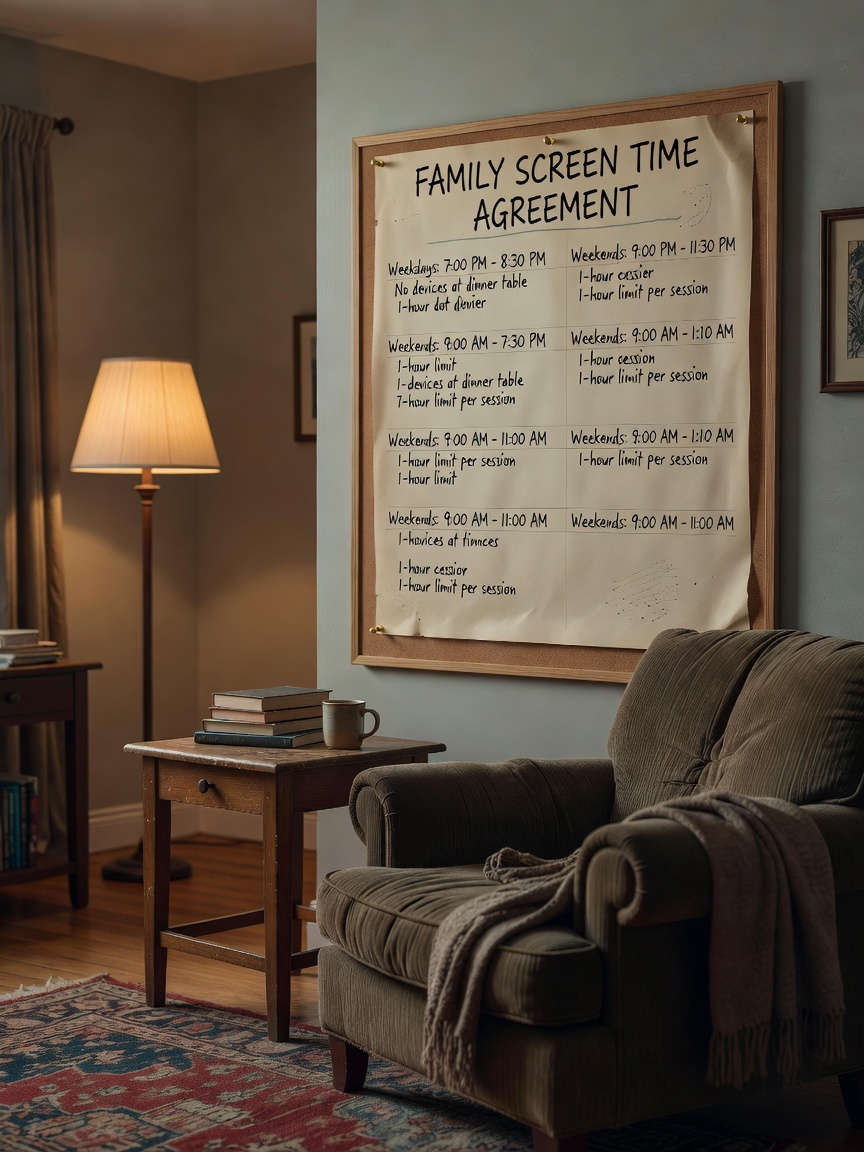
Family screen time rules are a set of guidelines established within a household to manage the duration, content, and context of digital device usage by children and teenagers. The goal is to promote healthy digital habits, ensure safety, and balance online activities with other aspects of life like school, sleep, and family interaction.
Kinnect is now LIVE! Start your private family group today.
👉 Try Kinnect on the Web
👉 Download the iOS App
I remember the constant knot in my stomach. It wasn't just about the hours logged on a tablet; it was the disconnect. Every dinner felt like a negotiation, every request to 'get off the phone' felt like a battle I was losing. We were sharing a home but living in different digital worlds. The fight isn't about the screen; it's a fight to get our family back, to feel like we're on the same team again.
The mistake most of us make is treating screen time like a single problem with a single rule. But it's more like an octopus—a complex thing with many arms. One arm is about time, sure, but others are about what they're watching, who they're talking to, and how they're behaving online. Instead of trying to wrestle the whole thing, let's create a plan that addresses each arm, together.
Building Your Family Tech Agreement: A Tentacle for Everything
Tentacle 1: Time & Place Boundaries (The 'When' and 'Where')
This is about creating sacred spaces. Maybe it's no phones at the dinner table or devices charging in the kitchen overnight, not in bedrooms. This isn't about punishment; it's about creating pockets of time to actually see each other's faces without a blue glow. It's for the silly jokes over dinner that you can never get back.
Tentacle 2: Content Quality (The 'What')
Shift the conversation from quantity of time to quality of content. An hour spent learning to code, creating digital art, or video-calling a grandparent is fundamentally different from an hour passively scrolling a feed. The goal is to help them turn the screen into a tool for creativity and connection, not just a pacifier.
Tentacle 3: Digital Citizenship (The 'How')
This covers kindness, privacy, and safety. We talk about 'stranger danger' in the park; we need to have the same conversations about DMs and friend requests. It’s about building an understanding of how to be a good human, both online and off, and what to do when they see behavior that isn't.
Tentacle 4: The Family Negotiation (The 'Our')
This is the most important tentacle. Don't just present a list of rules. Sit down and draft this agreement with them. Ask them what they think is fair. When they have a voice in creating the rules, they have ownership. It stops being your mandate and starts being our family plan.
The Hidden Variable: The Illusion of 'Family Time'
The conventional wisdom is that any time spent together is good time. But our research shows the 'Messaging Noise' phenomenon: 70% of family group text messages are logistical noise (memes, 'ok' responses), which buries meaningful connection. True connection isn't about the volume of messages; it's about creating a dedicated space, free from noise, to share what matters. Enforcing screen time isn't just about limiting the bad; it's about making intentional space for the good.
Research backs this up: Families who find ways to share activities at least once a week show 36% stronger family cohesion scores. This agreement is your roadmap to finding those moments.
Building this agreement requires a private, consistent space to have these conversations and live them out. Public social media like Facebook is designed for performance and distraction, and group chats on WhatsApp get buried in logistical noise. Kinnect was built to be the quiet, private home for your family's most important connections. It's where you can build your family's culture, share the moments that matter, and create a living history, away from the noise.
How do I get my child to follow screen time rules?
Involve them in creating the rules. When a child has a voice in setting the limits, they feel ownership and are more likely to adhere to them. Frame it as a family agreement for everyone's well-being, not a top-down punishment.
What are the screen time rules for a 13-year-old?
There's no magic number, as it depends on the teen's maturity and needs. A good starting point is focusing on balance: ensuring screens don't interfere with sleep (at least 8-10 hours), schoolwork, family meals, and physical activity. The rules should be a conversation, not a command.
Is it OK to take away screen time as a punishment?
While it can be effective for tech-related misbehavior, using it for everything can create a power struggle and make screens seem even more valuable. It's often better to link consequences to the action. For example, if they break a rule about online kindness, the consequence might be a discussion and a temporary loss of social media privileges, not their entire device.
Learn more at Kinnect.
