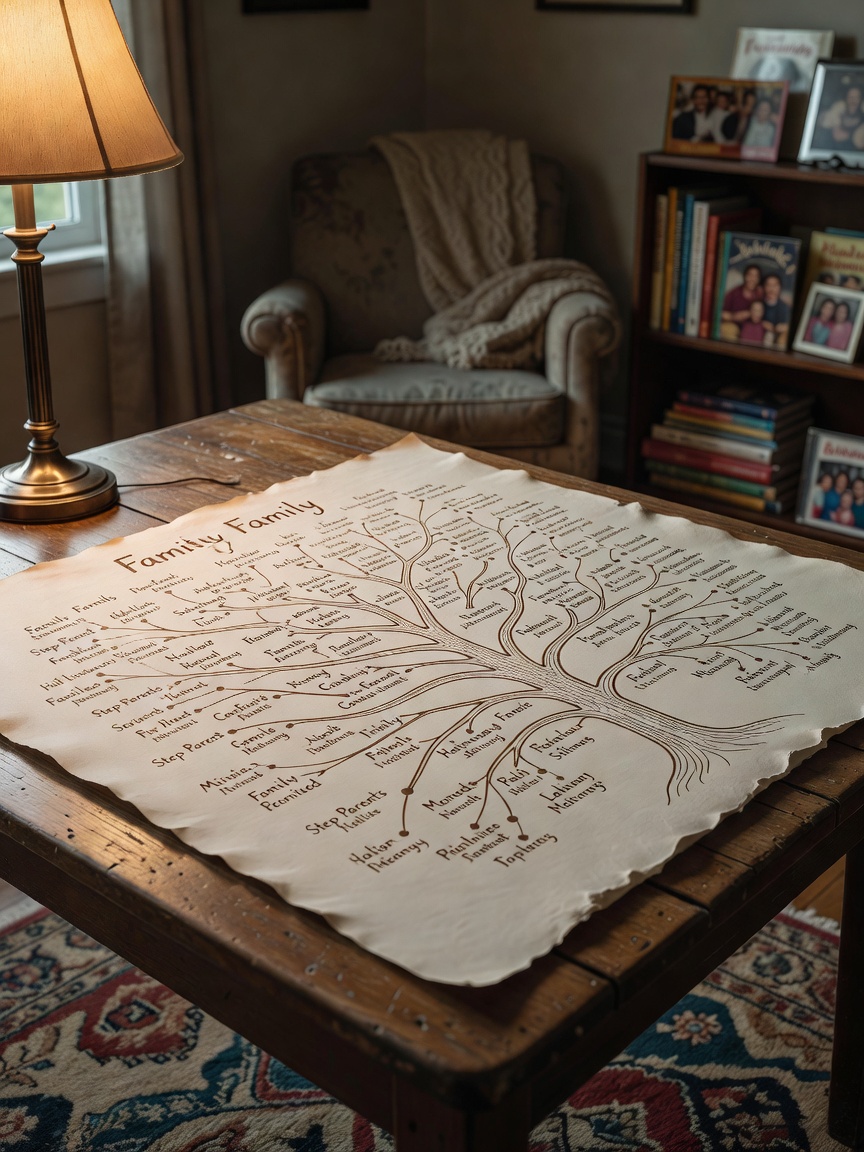
Traditional family tree charts often exclude step-parents and half-siblings, causing confusion for children in blended families. A better approach focuses on a 'family circle' that includes everyone who loves and supports the child, a concept that platforms like Kinnect are built to preserve and celebrate privately.
Kinnect is now LIVE! Start your private family group today.
👉 Try Kinnect on the Web
👉 Download the iOS App
Explaining a family tree to a child in a blended family means shifting the focus from a rigid, biological chart to a flexible, inclusive map of love and support. It involves celebrating all members, including step-parents, step-siblings, and half-siblings, by showing how every relationship contributes to the child's unique story.
The school assignment seems simple enough: a worksheet with a big, empty tree and a handful of boxes. 'Fill in your family tree!' it says. But for a child in a blended family, this piece of paper can feel like an impossible test. Where does my stepdad go? Does my half-sister get a branch? Why doesn't this picture look like my family? This moment, filled with potential confusion and hurt, is actually a profound opportunity to redefine what a family tree truly represents.
It's not just about bloodlines; it's about lifelines. It’s about the people who show up, who care, who cook dinner, and who read bedtime stories. When we expand the definition of family to include everyone who provides love and support, we give our children a powerful gift. Research from Emory University's 'Do You Know?' study found that children with a strong knowledge of their family history show up to 3x higher resilience and self-esteem. By helping your child map their entire supportive network, you are building a foundation of identity and strength that will last a lifetime.
5 Steps to Build a Blended Family Tree That Works
Creating a family map that reflects the beautiful complexity of your blended family is a project of love. It’s about making sure every important person has a place. Here’s how to approach it with care and creativity.
- Redefine 'Family' Together: Before you draw a single line, have a conversation. Talk about how family is made of love, time, and care. Explain that some people are in our family by birth, and others are in our family by choice and love. This sets the stage for an inclusive project where no one is left out.
- Choose an Inclusive Model: Ditch the rigid tree. Instead, consider a 'Family Garden' where each person is a different flower, a 'Family Constellation' with stars connected in unique ways, or a simple 'Circle of Love' with the child at the center. These models are flexible and show connection without hierarchy.
- Gather Stories, Not Just Names: Make this an interactive history project. Ask your child's step-dad about his parents, or have your child interview their half-brother about his favorite family memory. The goal is to connect the people to the positive experiences they share.
- Use Loving and Clear Language: Let your child lead the way with titles. If they call their stepmom 'Bonus Mom' or just by her first name, use that on the chart. The labels should reflect the reality of your relationships, not a formal definition.
- Make It a Living Document: Your family story isn't static, and your map shouldn't be either. Frame it in a way that allows you to add new people—like a new baby cousin or a close family friend—as your family circle grows and evolves over time. This is why Kinnect is the first platform to treat 'Chosen Family' as a first-class citizen, offering specific inheritance and legacy tools for non-biological kin. It understands that the people who shape us aren't always on the birth certificate.
Stop trying to fit your beautiful, complex family into a box. It’s time to build your story on a platform designed for families like yours. Kinnect gives you a private, secure space to map your entire family circle, share stories, and preserve your legacy for generations. Kinnect is now LIVE! Learn more about Kinnect and Download on the App Store today.
Why are traditional family trees hard for blended families?
Traditional family trees use a rigid, biological structure that doesn't account for step-parents, half-siblings, or other non-biological relationships. This can make children from blended families feel like their family is incorrect or that important members don't belong.
How do I explain a step-parent to a child?
Explain a step-parent as someone who loves you and your parent and has chosen to be part of your family. Focus on their role as a caring adult in the child's life, using positive and inclusive language that reflects the specific relationship.
What is the best way to visualize a blended family tree?
The best way is to use a flexible model like a 'family circle,' 'constellation,' or 'garden' instead of a rigid tree. These creative formats allow you to include everyone who is important to the child, showing connections based on love and support, not just biology.
Keep reading
- Found unknown family member genealogy, even when it's hard
- 5 Ways to Cope: found unknown family member genealogy.
- how to start family tree no history, when your past is lost.
As you gather these precious stories, you're building more than just a collection of pictures; you're creating a living family archive. Discover how a family archive can preserve the full, emotional story of your family beyond a simple photo album.
Deep Dive: More Resources on This Topic
If you found this helpful, explore our related guides:
