Most families do not lose their history because nobody cared. They lose it because preservation requires doing several things at once — capturing, organizing, storing, and sharing — and most tools only do one of them well.
You can record your grandmother's voice on your phone. But if the file is buried in your camera roll, unlabeled, and never shared with your cousins, it is functionally lost. The recording exists. The history does not.
Real family history preservation works in layers. Here is what each layer requires.
Layer 1: Voice and story capture
This is the hardest layer to get right and the most important. Written records can be transcribed later. Voices cannot be reconstructed. Recording the people in your family talking — telling stories, answering questions, explaining how they think — is the irreplaceable layer of family history.
The best approach: ask open questions and let them talk. What was your childhood like? How did you meet your partner? What do you believe now that you did not believe at 30? Record the answers. Do not edit. Do not try to make it perfect. Just capture.
Layer 2: Photo and document digitization
Physical photos, letters, and documents need to be scanned before they deteriorate. A flatbed scanner produces better results than a phone camera for important documents. Services like ScanMyPhotos can process large batches. The resulting files need to be stored somewhere accessible to the whole family — not just on one person's hard drive.
Layer 3: Context and organization
A photo without a caption loses meaning within one generation. A recording without context — who is speaking, when, about what — becomes unidentifiable within two. Every piece of family history needs enough context attached to it that someone who never met the person can understand who they are looking at or listening to.
Layer 4: Redundant storage and sharing
Anything stored in only one place will eventually be lost. Family history needs to exist in at least two locations — ideally one cloud-based and one that the whole family can access. This is where most personal archiving efforts fail: one person does the work, stores it locally, and the rest of the family never has access.
The Tools That Actually Work Together
No single tool handles all four layers. The practical stack that most families end up with combines a scanning service for physical materials, cloud storage for files, and a family memory platform for the ongoing capture and sharing layer.
For the ongoing capture layer — the conversations, voice recordings, stories, and questions that need to keep happening as long as your family members are still alive — Kinnect is built specifically for this. It is a private, invite-only platform where families record voices, share daily stories, save recipes with the voice of whoever taught them, and build a shared archive that every family member can access.
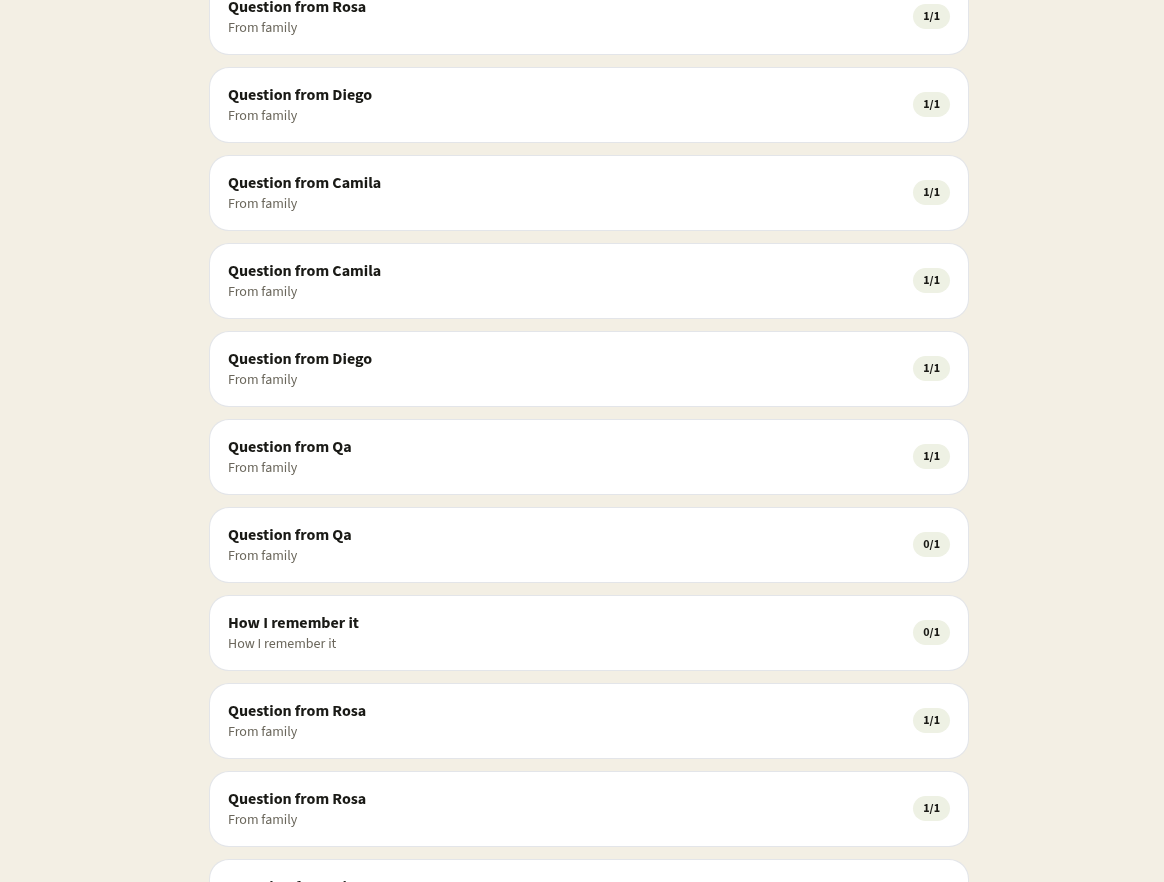
The key distinction from generic cloud storage: Kinnect gives families a reason to keep adding to the archive. Echo sends one question every 24 hours to your family group. Every answer builds the record. After a year, you have 365 entries. After five, you have something that no box of unlabeled photos can replicate.
Invite the people who belong. at kinnect.club. Founding memberships $9.99/year — less than one coffee a month.
Keep reading
Kinnect is now LIVE!
Experience the private family network on the web or download the iOS app today.