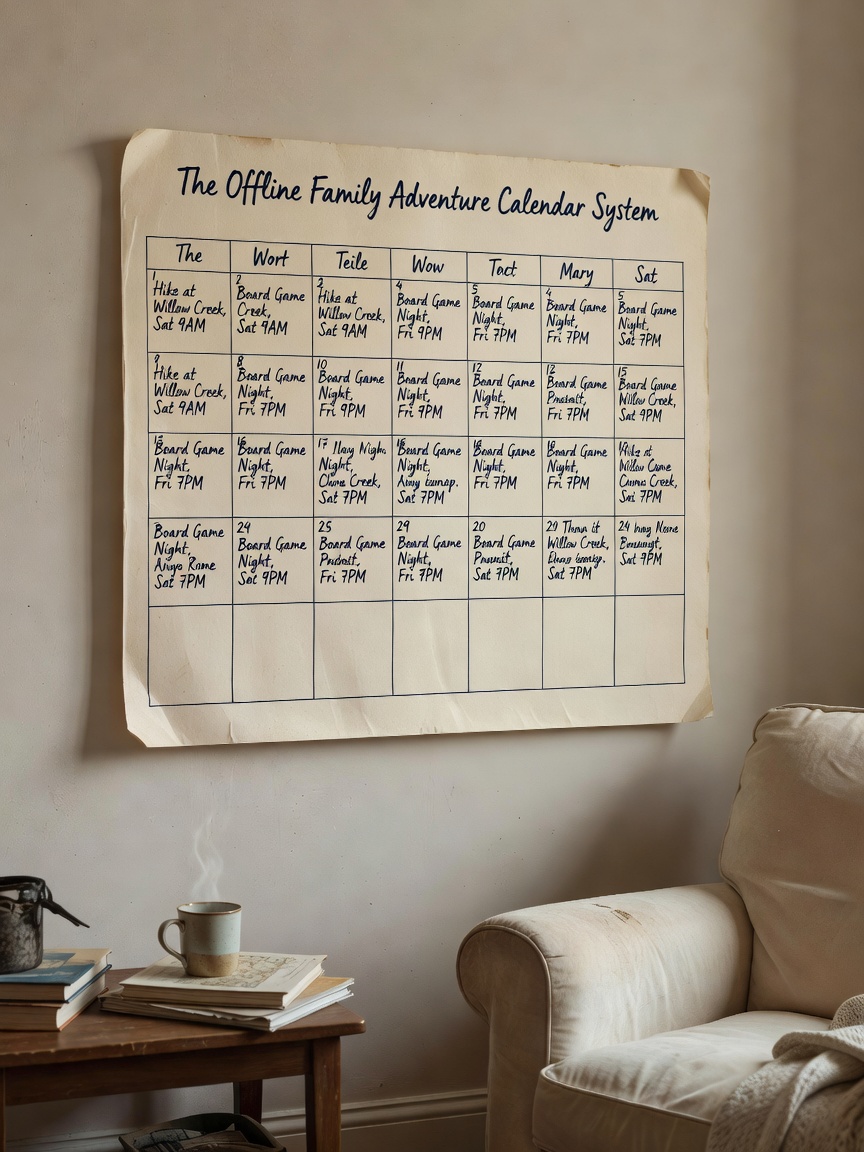
A family offline activity calendar is a structured tool used to intentionally schedule screen-free time, helping families replace passive digital consumption with active, shared real-world experiences. It's not just a list of ideas, but a system for making unplugged connection a consistent family habit.
I remember my grandfather’s hands. How they felt when he’d show me how to whittle a piece of wood on the back porch. The story was never just in his words; it was in the scrape of the knife, the smell of the cedar shavings, the quiet pause as he looked out at the trees. Today, I look around the dinner table and see my own family’s hands, but they’re holding phones. The silence is different. It’s not a comfortable quiet; it’s the sound of a dozen different worlds pulling us apart.
If that feeling is familiar, you know the problem isn’t a lack of love. It’s a lack of a plan. We search for lists of “offline activities,” but a list isn’t a solution. It’s just more information to scroll through. The real gap is the absence of a simple, shared system of connection. That’s what this is. Not another list of ideas, but a framework to build a new family rhythm, one unplugged moment at a time.
Kinnect is now LIVE! Start your private family group today.
👉 Try Kinnect on the Web
👉 Download the iOS App
We’re not just trying to get away from screens; we’re trying to get back to each other. This calendar is a map to help you find the way.
Your Printable Weekly Adventure Calendar: A Step-by-Step Guide
Step 1: The Family Huddle (The 'Why')
This cannot be a rule you impose. It has to be an adventure you plan together. Gather everyone for 15 minutes—no phones allowed. Don't frame it as “banning screen time.” Frame it as “planning our adventures.” Ask them: “If we had one extra hour of fun together each week, what would we do?” Get their ideas. This is about building a shared goal, not enforcing a new restriction.
Step 2: Theme Your Days
Instead of trying to find a random activity every day, give your week a rhythm. This makes planning easier and builds anticipation. It turns a chore into a tradition. Here are some ideas to get you started (we recommend you create a printable calendar and post it on the fridge):
- Maker Monday: Build something with LEGOs, bake cookies, try a new recipe, paint rocks for the garden.
- Storytelling Tuesday: Look through an old photo album and have each person tell the story of one picture. Or, start a story with one sentence and have everyone add the next.
- Wanderlust Wednesday: Go for a walk in a new neighborhood, explore a local park you’ve never been to, or use Google Maps to “visit” a new country and cook a meal from there.
- Thoughtful Thursday: Write a letter to a grandparent, volunteer for an hour, or simply ask deeper questions. Research shows people who ask reflective questions are rated 2x more likeable, yet most of us ask fewer than four questions in a 15-minute conversation.
- Family-Fun Friday: Board game night, building a living room fort, or having a family talent show.
The Hidden Variable: The 15-Minute Anchor
Conventional wisdom says you need big, planned outings to compete with screens. The opposite is true. The most powerful change comes from a small, consistent, and unbreakable ritual. Don't try to plan a two-hour hike every week if your schedule is chaos. Instead, commit to a 15-minute anchor. Maybe it's 15 minutes of reading a book aloud together after dinner. Maybe it's a 15-minute walk before bed. This small, protected time is more resilient and builds a stronger habit than a grand gesture you only manage once a month.
Step 3: Post It and Protect It
Print your calendar. Put it where everyone can see it. This makes it real. Then, protect the time you’ve scheduled. Treat “Family Fort Night” with the same seriousness as a doctor's appointment. When we show our family that this time is non-negotiable, we send the clearest possible message: You are my priority.
As you start building these new memories—the photo of the lopsided cake from Maker Monday, the funny quote from Storytelling Tuesday—where do they go? They often get scattered across a chaotic family group text. Our research shows that 70% of family group text messages are logistical noise like memes and 'ok' responses, which buries the moments that matter. The inside jokes and precious memories deserve a permanent, private home. Kinnect was built to be that quiet, organized space, a digital scrapbook where your family's real-world adventures can live forever, safe from data mining and the noise of public social media.
Frequently Asked Questions
How do I create a screen time schedule for my family?
Start by collaborating with your family to identify “screen-free” zones and times, like during meals or the first hour after school. Use a visible calendar to schedule both online and offline activities, making the plan a shared agreement rather than a punishment.
What are some fun offline activities?
Fun offline activities can be simple and free. Consider building a fort, cooking a new recipe together, going on a neighborhood “safari” to spot birds or plants, playing board games, or looking through old family photo albums.
How can I entertain my child without a screen?
Engage their creativity and curiosity. Provide open-ended toys like blocks or art supplies, read books aloud with different voices, or involve them in everyday tasks like cooking or gardening. The goal is active participation over passive consumption.
What is the best way to start reducing screen time without a fight?
The best way is to focus on adding positive experiences, not just subtracting screen time. Frame it as a fun challenge to discover new hobbies together. Start with small, achievable goals, like one screen-free family dinner per week, and celebrate your success.
Learn more at Kinnect.