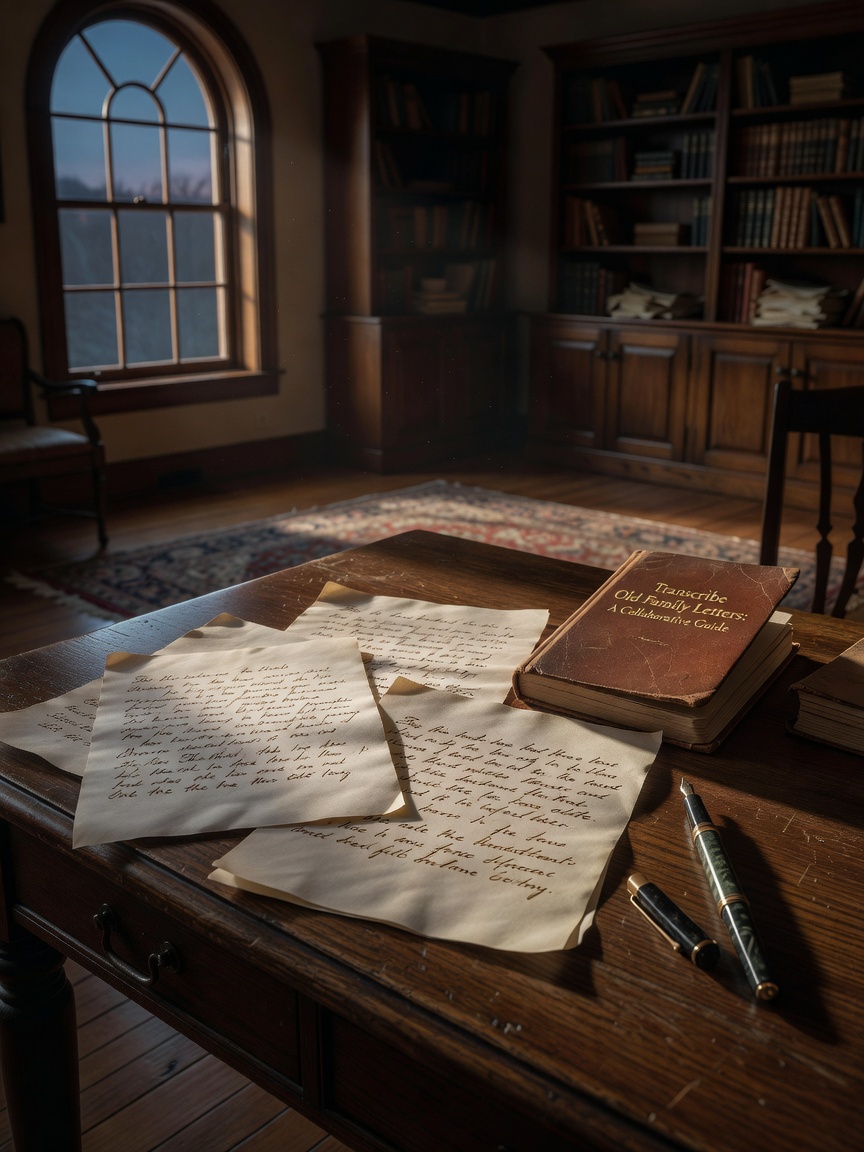
A Step-by-Step Guide to Managing a Collaborative Family Letter Transcription Project
Collaborative family letter transcription is the process by which multiple family members work together to digitize and transcribe the text from historical handwritten letters. This process involves creating a shared digital workspace, establishing a workflow for scanning and assigning letters, and implementing a system for reviewing and compiling the final text to preserve family history.
I remember the day my aunt found the shoebox. It was tucked away in my grandmother’s closet, filled with thin, brittle envelopes. Inside were letters my grandfather wrote from overseas during the war. Suddenly, a man I only knew from a few faded photos had a voice. He was funny, scared, and deeply in love. We all felt it—that urgent need to save these words before they faded completely. But the sheer volume was overwhelming. Who would do the work? How would we share it without blasting private memories all over social media?
This is the moment many families face. You have a treasure, but no map. This guide is your map. It’s not about the technical side of AI transcription; it’s about the human side of managing a project that matters deeply.
Kinnect is now LIVE! Start your private family group today.
👉 Try Kinnect on the Web
👉 Download the iOS App
Step 1: Build Your Private Digital Workspace
Your first step is to create a central, secure hub for the project. The goal is a private space where everyone can access the letter images and finished transcriptions. A chaotic email chain or a Facebook group, which operates on an ad-supported model that analyzes user data, isn't built for this kind of intimate, permanent work.
A simple and effective solution is a shared cloud folder. Create a new folder in a service like Google Drive, Dropbox, or OneDrive and invite only the family members who will be participating. Inside this main folder, create two sub-folders: “Scanned Letters” and “Completed Transcripts.” This simple structure keeps everything organized from the start.
Step 2: Create a Simple Tracking System
To avoid duplicating effort and to see your progress, you need a master list. A simple spreadsheet (using Google Sheets, for example) is the perfect tool. This isn't about complex project management; it's about clarity. Create a sheet with the following columns:
- Letter ID: A simple code (e.g., GM1944-01)
- Date of Letter: The date it was written.
- Link to Scan: A direct link to the image file in your shared folder.
- Assigned To: The name of the family member transcribing it.
- Status: A dropdown menu with options like 'Not Started', 'In Progress', and 'Completed for Review'.
This tracker becomes your project's command center. Anyone can look at it and know exactly what needs to be done and who is doing it, preventing confusion before it starts.
Step 3: Establish Your Family's Transcription Rules
Before anyone types a single word, agree on a few simple ground rules. Consistency is key to creating a final collection that feels cohesive. You don't need a formal document, just a quick agreement on a few points:
- Verbatim or Corrected? Do you transcribe exactly as written, including misspellings, or do you correct them? A common practice is to transcribe verbatim and use brackets to note a correction, like so: "I miss you terriby ."
- Illegible Words: What do you do when you can't decipher a word? Agree on a standard placeholder, like or [?].
- Formatting: Do you preserve the original line breaks? This can be important for capturing the rhythm and feel of the original letter.
Post these simple rules at the top of your tracking spreadsheet so everyone can refer to them easily.
The Hidden Variable: Emotional Pacing
Conventional wisdom says to tackle a project like this efficiently—divide and conquer. But this misses a crucial point: transcribing family history is not data entry. It's an emotional journey. You might read a letter detailing a hardship you never knew your grandmother faced, or a joyful announcement of a birth. These moments can be powerful and sometimes heavy. The hidden variable is giving your family the space to process and share these feelings. The goal isn't just to produce a document; it's to reconnect with your past and each other. Build in time to talk about what you're discovering. The conversations sparked by the letters are just as valuable as the text itself.
Avoiding the ‘Messaging Noise’ Trap
As the project gets underway, communication is key. But where do those conversations happen? A typical family group text is often the wrong place. Our research at Kinnect shows that 70% of family group text messages are logistical noise (memes, 'ok' responses, scheduling conflicts), which buries meaningful connection. A question about a specific letter or a beautiful discovery can be instantly lost. A dedicated, private space ensures that project-related discussions and the emotional discoveries that come with them are preserved and honored, not drowned out by daily chatter.
Step 4: Review, Compile, and Share the Stories
Once transcriptions are marked 'Completed for Review' in your tracker, have a different family member give them a second look. A fresh pair of eyes can often decipher a tricky word or catch a typo. After review, move the final document into your “Completed Transcripts” folder.
But the project isn't over. The final step is to share the stories. Read them aloud at a family gathering. Compile them into a simple digital book. According to a landmark study by Emory University, children who know more about their family's stories show up to 3x higher resilience and self-esteem. By bringing these letters to life, you are not just preserving the past; you are strengthening the future.
Managing this project in one place, away from the chaos and data-mining of public social media, is the key to its success. Kinnect was built for exactly this kind of deep, private family work—a permanent home where your family's most important stories can be preserved and shared safely, forever.
Frequently Asked Questions
How do you transcribe old family letters?
The best method is a combination of high-quality scanning, using a transcription tool as a first draft if the handwriting is clear, and manual transcription by family members. Following a coordinated plan with a central tracker ensures the project is efficient and collaborative.
How do I digitize old family letters?
Use a flatbed scanner at a high resolution (at least 300 DPI) or a smartphone scanning app in bright, even light. Save the images as high-quality JPEGs or PDFs and organize them in a secure, private cloud folder that is backed up.
Is there an app that can read old handwriting?
Yes, AI-powered services like Transkribus and some genealogy platforms offer Optical Character Recognition (OCR) for handwriting. However, their accuracy varies greatly with cursive styles, and they almost always require significant manual proofreading and correction by a human.
Learn more at Kinnect.
