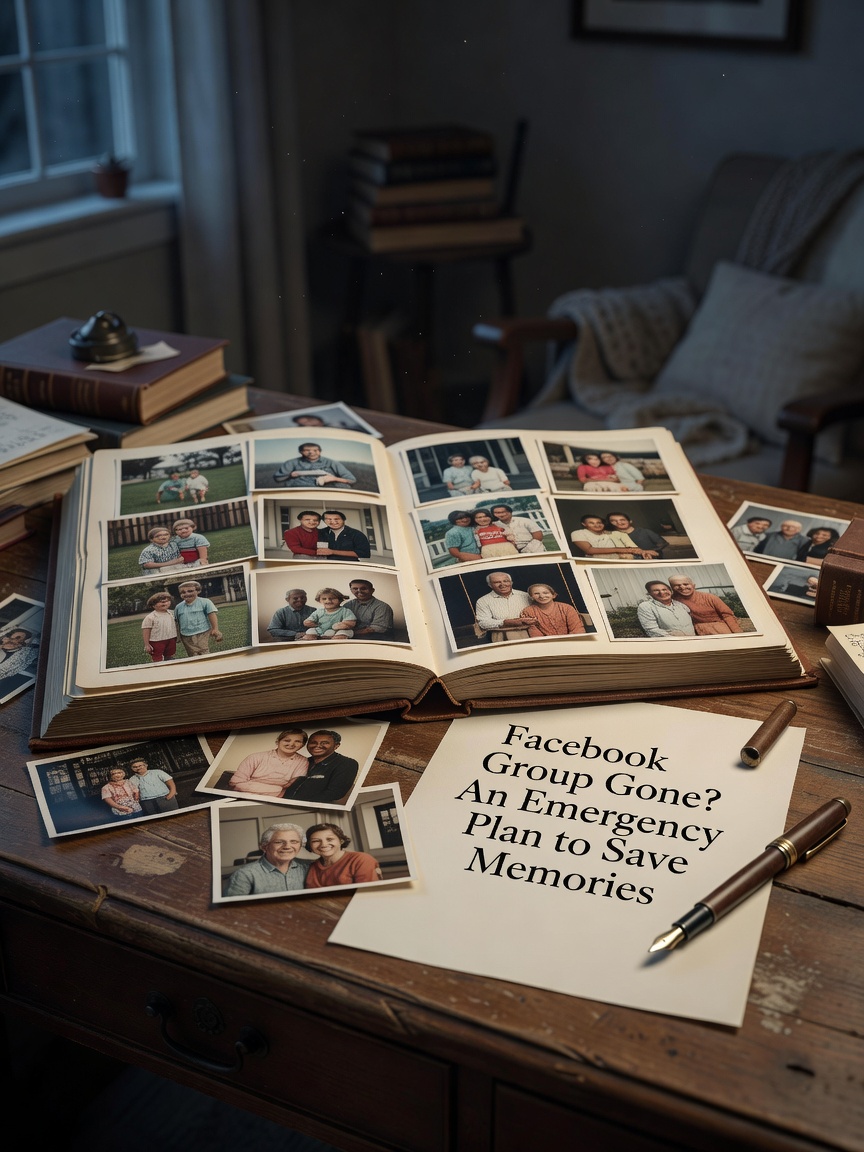
When a family's Facebook group is deleted or the platform disappears, years of digital memories are at risk. The immediate priority is to use Facebook's 'Download Your Information' tool to export data, after which families can regroup on a private family social network like Kinnect, designed for permanent preservation.
The deletion of a family Facebook group is the permanent removal of a shared digital space, including all posts, photos, videos, and member lists. This can occur due to platform-wide shutdowns, accidental administrator action, or violations of the platform's community standards, often leaving members with no way to recover their shared history.
Kinnect is now LIVE! Start your private family group today.
👉 Try Kinnect on the Web
👉 Download the iOS App
I remember the hollow feeling in my stomach when I realized my dad's old voicemails were gone forever, deleted when I switched phones. It wasn't the phone I missed; it was the sound of his voice. That's the same panic you might feel realizing your family's digital scrapbook—that Facebook group filled with birthday videos, graduation photos, and late-night chats—could simply vanish. It’s not just data; it's your story.
When the place where you’ve stored those memories is suddenly at risk, the first instinct is to panic. Don't. Let's breathe and take action. This isn't about finding a 'Facebook alternative' right now. This is triage. This is about saving what you can, right now, before it's too late.
Step 1: Immediately Try to Archive Your Group's Content
If you still have access but fear the group could be deleted, you need to act fast. Facebook has a tool for this. Go to your group, find the 'More' dropdown menu, and select 'Group Settings.' You might find an option to 'Archive Group,' which freezes it but preserves the content. A more robust solution is using Facebook's Download Your Information tool. You can request a file of your posts, photos, and videos. It can be a clunky process and take time, but it's the most official way to create a backup.
Step 2: Triage and Manually Save the 'Crown Jewels'
The download tool can be slow. While you wait, go through the group and manually save the most important things. Think like a firefighter in a burning museum. What can't be replaced? The video of Grandma telling her life story. The photos from the last family reunion. The announcement of a new baby. Right-click and save those images and videos to a dedicated folder on your computer. It's not elegant, but it's effective in an emergency.
Step 3: Establish a New Rally Point
Your family is scattered and confused. The immediate priority is to get everyone in one place to communicate next steps. Don't try to pick a new permanent platform yet. Create a simple, temporary group text, WhatsApp chat, or email thread. Send one clear message: "The Facebook group is gone/at risk. I'm saving our memories. We will regroup here for now. Please confirm you got this." This stops the panic and re-establishes connection.
From Triage to Thriving: Building a Permanent Home for Your Family
Once the immediate fire is out and you've rescued what you can, you can finally take a full breath. That feeling of panic was a signal. It was your heart telling you that your family's story is too precious to be stored in a rented space, especially one that doesn't have your best interests at heart. A platform like Facebook is a public square, built on an ad-supported business model. Its primary goal is to gather data to sell advertising. This is why 72% of Americans say they are concerned about the amount of personal information tech companies collect. Your family needs a private home, not a billboard.
A dedicated family platform operates on a fundamentally different principle. It's a private, secure space built for one purpose: to connect and preserve your family's history. The business model is aligned with your goals—often a subscription—meaning the company works for you, not for advertisers. The features are designed for strengthening bonds, not for generating engagement metrics.
The Hidden Variable: The Legacy Preservation Gap
We often think about saving funny photos or vacation highlights. But the real crisis of digital memory is much deeper. Our research revealed a heartbreaking insight: 85% of Gen X adults report they wish they had recorded their parents' voices before they passed, yet only 12% have a system in place to do so. This is the Legacy Preservation Gap. We are losing the most important parts of our loved ones—their stories, their advice, their laughter—because the platforms we use are designed for fleeting moments, not permanent legacy. A Facebook group is a chronological feed of posts; it was never designed to be an archive of a human life.
The panic you felt wasn't just about losing pictures. It was about the threat of losing connection to the people who define you. Building a permanent digital home is the answer. It's a deliberate act of choosing to protect your family's story, ensuring that future generations can not only see photos of their ancestors but can also hear their voices and learn from their wisdom. It's about turning fleeting digital moments into a lasting family legacy.
What is the best alternative to a Facebook group for families?
The best alternative is a private, dedicated family platform like Kinnect. Unlike public social media, these apps are built specifically for family communication and memory preservation, without an ad-based business model, ensuring your data remains private and your space is secure.
What is the Facebook group privacy problem?
The core privacy problem is that Facebook's business model relies on collecting user data, including interactions within groups, to target advertising. Even in 'private' groups, your family's information and photos are part of a system designed for data monetization, not true privacy.
How do I convince my family to leave a Facebook group?
Focus on the feeling of security, not just features. Remind them of the panic of potentially losing everything. Frame it as moving from a public park to a private, cozy home where their most precious memories of children and grandchildren are safe from data mining and permanent.
Learn more at Kinnect.
