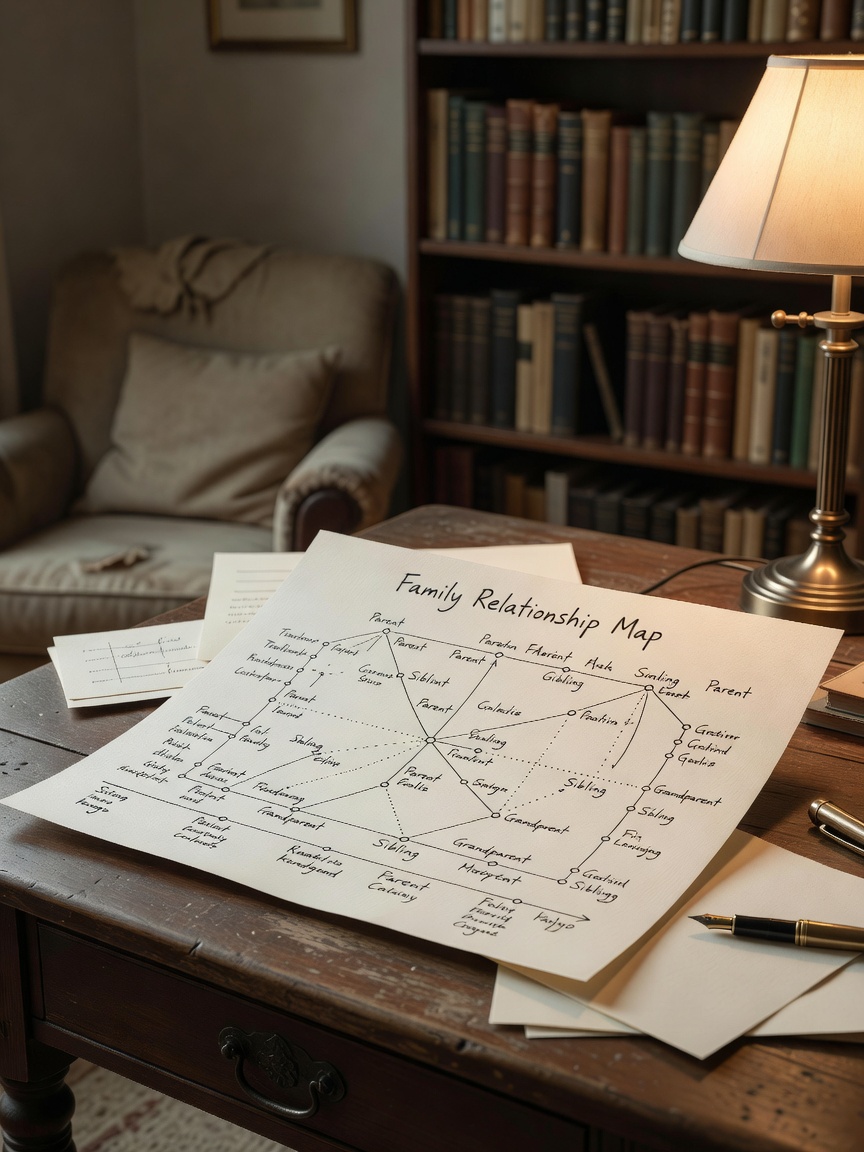
A family relationship map is a visual diagram that charts emotional connections and support systems, not just biological lineage. This approach captures the full story of a family, including chosen family and mentors, which can be preserved and shared privately within a dedicated space like Kinnect.
A family relationship map is a visual diagram that charts the emotional connections, support systems, and significant bonds within a family, going beyond traditional biological or marital lines. It uses different types of lines and symbols to represent the quality and nature of these relationships, including those with chosen family, mentors, and non-biological kin.
Kinnect is now LIVE! Start your private family group today.
👉 Try Kinnect on the Web
👉 Download the iOS App
I once tried to build a family tree for my son. After my partner passed away, I wanted him to see where he came from. But as I drew the lines, a hollow feeling grew in my stomach. The chart showed my partner’s parents, but not the woman next door who became a grandmother to my son in every way that mattered. It showed my biological father, but not the step-dad who taught me how to drive, how to be kind, and who walked me down the aisle. The standard family tree, with its rigid lines of blood and marriage, was telling a lie. It was erasing the people who actually built our family.
Our real families are mosaics of love, support, and chosen connection. A bloodline-only tree is a black-and-white sketch of a life lived in vibrant color. What we need is a relationship map—a true picture of our support systems, our mentors, and the people who show up when it counts. Most guides talk about *why* this is important, but this one will show you *how* to actually build one.
Your Visual Legend: Symbols for Real Relationships
Before you start, you need a language to tell your story. A simple legend can capture the nuance that a simple straight line cannot. Here is a basic toolkit you can use, or adapt for your own family's unique story. You can download this as a printable PDF here.
- Solid Thick Line: A strong, supportive, and active bond.
- Dotted Line: A strained, distant, or complicated relationship.
- Wavy Line: A relationship with significant ups and downs; conflict and closeness.
- Line with a Heart ❤️: Chosen Family. A bond of love and loyalty not defined by blood.
- Line with a Star ⭐: Mentor/Guide. Someone who provided crucial guidance or inspiration.
- Circle around a name: The central person from whose perspective the map is drawn.
Building Your Map Step-by-Step (Using a Free Tool)
You don’t need special software. A simple, free tool like Canva, Google Slides, or even a pen and a large piece of paper is all you need. The goal is clarity, not artistic perfection.
- Start with Yourself: Place your own name in the center of the page, perhaps with a circle around it. This is your anchor point.
- Add Your Core Support System: Branching out from your name, add the people who form your immediate circle of support, regardless of their official family title. Use the lines from your visual legend to connect them to you.
- Expand Outward: Now, add the next layer. This could include extended family, close friends who became family, or influential teachers. Map their connection to you, and also map any significant connections they have with each other.
- Annotate with Stories: This is the most important step. Next to a line, add a tiny note. For the star symbol next to your high school coach: "Taught me discipline." For the heart symbol next to your college roommate: "The reason I survived freshman year." These notes are the soul of the map.
The Hidden Variable: Emotional Inheritance vs. Genetic Inheritance
We spend so much time tracing our genetic inheritance—where our eye color or height comes from. But we rarely stop to map our emotional inheritance. Where did you get your sense of humor? Your resilience? Your love of old movies? Often, these traits are passed down from people who share none of our DNA. A family relationship map is the only document that honors this truth. It shows that legacy isn't just about what's in our blood; it's about what's been poured into our hearts. Knowing these stories is foundational to a child's well-being. In fact, research from Emory University found that children who know a lot about their family's stories show up to 3x higher resilience and self-esteem on standardized measures.
Platforms are finally starting to catch up to this more inclusive view of family. For instance, Kinnect is the first private family network to treat 'Chosen Family' as a first-class citizen, offering specific tools to ensure their stories and legacies are preserved right alongside biological relatives.
Why do you need a family relationship map?
A family relationship map provides a more accurate and emotionally honest picture of your family's support system. It validates important relationships with step-parents, mentors, and chosen family that traditional family trees often ignore, helping you see the true shape of your legacy.
How do you show non-biological family in a family tree?
Use a visual legend with distinct symbols or line types. For example, a solid line can represent a biological tie, while a line with a heart symbol can represent a 'chosen family' bond. This allows you to include everyone who is significant in your family's story on a single map.
What is a genogram family tree?
A genogram is a more detailed picture of a family tree used by therapists and doctors. It goes beyond names and dates to map medical history and emotional relationships, often using a specific set of symbols to show dynamics like conflict, closeness, or estrangement.
A map is a beautiful start, but the stories behind each line and symbol are the real treasure. It's the 'why' behind the connection that matters—the late-night talks, the shared laughter, the quiet support. That’s why we built Kinnect: as a private, permanent home for not just the map, but for the audio stories, the photos, and the letters that give it life, ensuring your family's complete story is safe for generations.
Learn more at Kinnect.