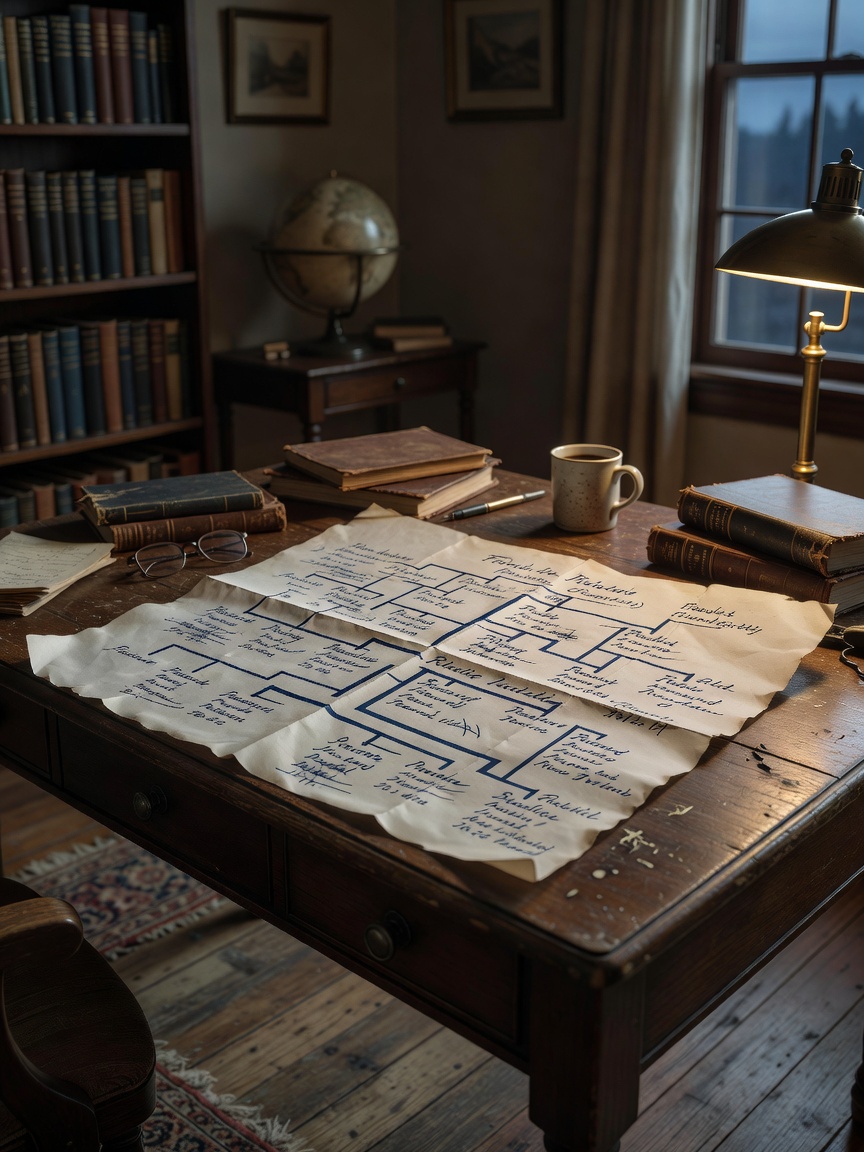
Resolving family tree discrepancies is the process of addressing conflicting information in genealogical records through careful research and sensitive communication with family members. This involves verifying data from primary sources, understanding the emotional impact of new discoveries, and collaboratively updating the shared family narrative in a private, respectful manner.
I remember the day I found it. A census record from 1920 with my great-grandmother's name, but listed with a family I’d never heard of. The story my grandmother had always told me about her mother's childhood suddenly felt... fragile. My first instinct was to call her and say, “I think we have it wrong!” But I stopped. This wasn't just a data point; it was her mother's story, a piece of her identity. Blindsiding her with a cold fact felt like a violation.
This is the moment so many of us face. We start a journey into our family's past to feel closer to them, but we end up uncovering secrets or errors that feel like they could push us apart. The internet offers countless tools for the research, but none for the relationship. How do you tell someone you love that a story they’ve cherished might not be the whole truth?
Kinnect is now LIVE! Start your private family group today.
👉 Try Kinnect on the Web
👉 Download the iOS App
Before You Speak: Assessing the Impact
Not every discovery needs to be shared, and timing is everything. Before you pick up the phone, you have to sit with the information and ask yourself a few hard questions. This isn't about hiding the truth; it's about delivering it with care and intention.
- What is my goal? Am I trying to be 'right,' or am I trying to build a more complete and honest picture of our family for everyone? The answer changes your entire approach.
- Who does this information directly impact? A discrepancy about a distant ancestor is very different from one that changes a living person's understanding of their own parent. Prioritize the people closest to the story.
- What is the potential emotional fallout? Consider the person's age, health, and emotional state. Is this knowledge a gift, or is it a burden they don't need to carry right now?
- Can I support my discovery? Don't start a sensitive conversation based on a single, unverified record from another user's public tree. Gather multiple primary sources—birth certificates, census records, military documents—so you're sharing a pattern, not just an anomaly.
The Conversation Framework: A Step-by-Step Approach
Step 1: Gather Your Story, Not Just Your Data
When you're ready to talk, don't lead with a stack of papers and a red pen. Lead with the story of your discovery. Frame it as a journey you're on. Instead of presenting facts like a prosecutor, invite them into the mystery with you. Show them the documents, but also share how you felt when you found them. This transforms the conversation from a confrontation into a shared exploration.
Step 2: Choose Your Moment and Your Space
This is not a conversation for a holiday dinner table or a chaotic family group text. Find a quiet, private moment where you have time and emotional space. One-on-one is almost always best. The goal is connection, and that requires an environment free of distractions and public judgment. Public genealogy platforms are built for broad collaboration, but they are the wrong venue for navigating the delicate, personal impact of a family secret.
The Hidden Variable: Emotional Inheritance
Conventional wisdom tells us to correct the facts in our family tree. The hidden variable is that you are never just correcting a fact; you are altering someone's emotional inheritance. The stories we are told about our grandparents, the hardships they overcame, the places they lived—these things form the bedrock of our identity. When you present information that challenges that, you're not just editing a database. You're asking someone to revise their own sense of self. The real work isn't data correction; it's co-creating a new, more complex story that everyone can still see themselves in.
Step 3: Use Gentle, Collaborative Language
Your words will either open a door or build a wall. Avoid accusatory language and use phrases that invite collaboration.
- Instead of: "You were wrong about Grandpa's birthplace."
Try: "I found some documents that suggest a different story about Grandpa's early life, and I'd love to figure it out with you." - Instead of: "The family tree is wrong."
Try: "The records I'm seeing are conflicting with what we've always heard. Can we look at them together?" - Instead of: "I discovered a family secret."
Try: "I came across something that surprised me, and it feels important to share it with you privately."
Step 4: Listen and Validate
After you've shared what you found, the most important thing you can do is stop talking and listen. They may feel shock, denial, anger, or sadness. Don't argue. Validate their feelings. Say, "I can see this is a lot to take in," or "It's okay to be upset. This surprised me, too." Remember, a shared family narrative is a powerful source of strength. A landmark study from Emory University found that children with more knowledge of their family history show significantly higher resilience and self-esteem. Your goal is to strengthen that narrative, even if it means making it more complex.
These conversations are too fragile for public forums, and the details are too precious to be buried in the logistical noise of group texts. The real work of weaving a new family story together needs a dedicated, private space. It's why we built Kinnect. It’s a place to share a sensitive document securely, to record the story of how you found it in your own voice, and to give everyone the time and space to process it together, without an audience. With the Legacy Preservation Gap showing 85% of adults wish they had recorded their parents' voices, a private space to save these stories becomes essential.
Frequently Asked Questions
How do you deal with a distant relative who messed up your family tree?
Approach them privately and kindly, assuming good intent. Share your sources and frame it as a collaborative effort, saying something like, "I have some conflicting information for this ancestor, can we compare notes?" Avoid making public edits without discussion, as it can feel aggressive.
What is the etiquette for correcting family tree errors?
The best etiquette is to be private, polite, and prepared. Contact the person who entered the information directly, provide clear sources for your correction, and propose a solution rather than just pointing out the mistake. Always thank them for their work and contribution.
How do you resolve conflicting information in genealogy?
Always prioritize primary sources (like birth certificates or census records) over secondary information (like another person's tree). When primary sources conflict, document the discrepancy and seek additional evidence, such as DNA testing, land records, or wills, to build a stronger case for one version of the story.
What to do if you find a secret in your family tree?
First, confirm the information with multiple, reliable sources. Then, carefully consider who the secret impacts and whether sharing it would be helpful or harmful. If you decide to share, do so privately and gently with the most directly affected living relatives first.
Learn more at Kinnect.
