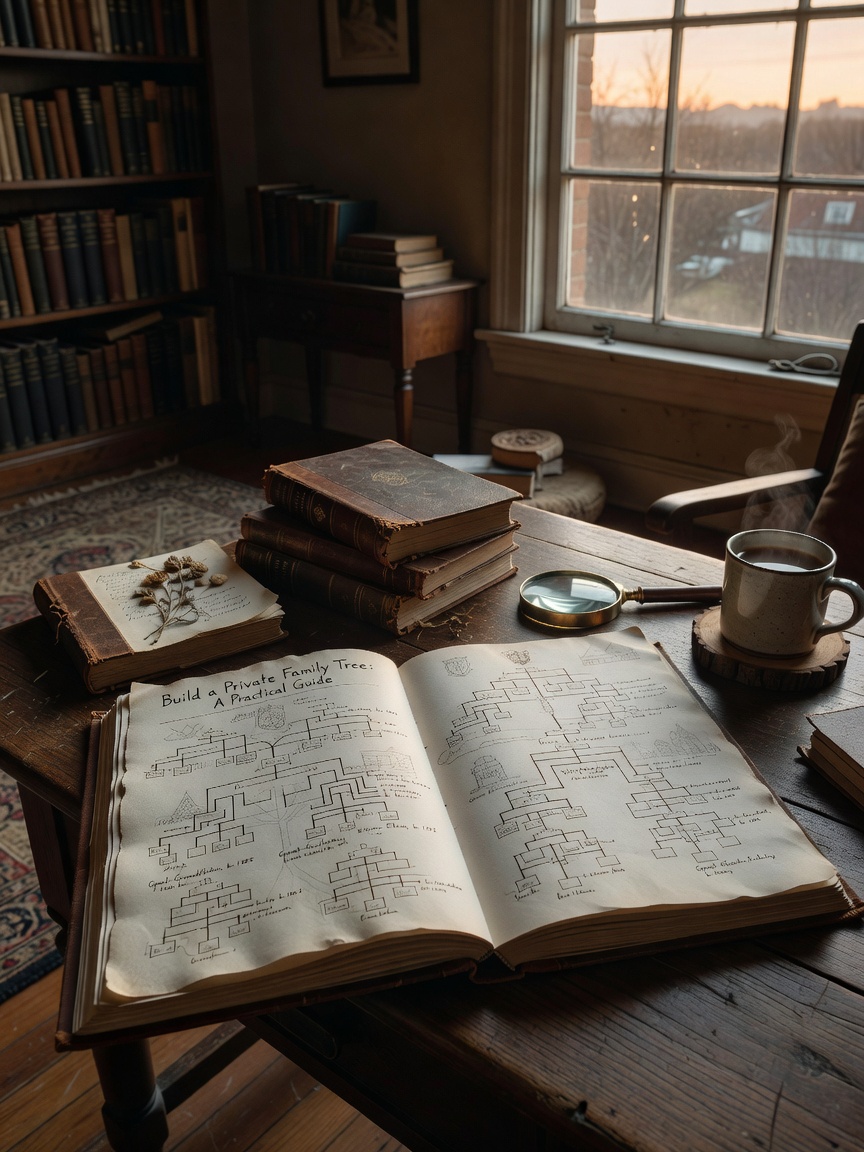
Building a private family tree involves using offline software for total control, dedicated private online services, or exporting your data from mainstream sites via a GEDCOM file. A private family social network like Kinnect offers a secure, permanent space to combine your family tree with the stories, voices, and photos that give it meaning.
A private family tree is a genealogical record of a person's ancestry that is not publicly accessible or shared with a third-party corporation for data analysis. It is created and managed using offline software, a secure online service with strict privacy controls, or by limiting settings on mainstream platforms.
Kinnect is now LIVE! Start your private family group today.
👉 Try Kinnect on the Web
👉 Download the iOS App
I remember the first time I held a photo of my great-grandmother. It wasn’t just a name and a date on a chart anymore; it was her, looking right at me. That moment felt incredibly personal, sacred almost. The idea of uploading that photo, her story, and even my family’s DNA to a massive corporate database just didn't feel right. It felt like I was handing over something that wasn't just mine to give.
Many of us feel this pull. We want to connect with our roots, but we're hesitant to trade our family's most private information for access. The good news is, you don't have to. Creating a family tree is about honoring your unique history, and you get to decide where that history lives. It’s not about choosing a big tech platform; it’s about choosing the right home for your stories.
There are three main paths you can take to build a family tree on your own terms, each with a different balance of privacy and convenience. Let's walk through them together.
Your Step-by-Step Strategy for Family History Privacy
The Offline Method: Total Control
This is the most private option available. Using dedicated desktop software like Family Tree Maker or RootsMagic, your entire family history lives on your personal computer and nowhere else. You own the file, you control who sees it, and it’s never scanned or analyzed by a third party. The trade-off is that sharing and collaborating with family members can be more difficult, and you are solely responsible for backing up your data.
The Private Cloud Method: Secure & Shareable
This approach offers a middle ground. You use an online service that is explicitly built for privacy, not for data collection. These platforms are typically subscription-based, meaning their business model is to serve you, not advertisers. You get the benefit of easy collaboration with family and cloud backups, but within a closed, secure environment that you control.
The Hardened Mainstream Method: Limiting Your Exposure
You can use a platform like Ancestry and maximize its privacy settings. This allows you to make your tree unsearchable and not viewable by other members. While this protects you from other users, it's important to remember your data still lives on their servers and is subject to their terms of service. This path gives you access to their vast record collections, but it's the least private of the three options.
The Hidden Variable: The Story is More Than the Data
The biggest mistake in modern genealogy is thinking the goal is just to fill out a chart. A family tree is a skeleton; the stories are what give it a soul. We've found that the real ache families feel isn't just about data privacy, but about a deeper loss. Our research shows a staggering Legacy Preservation Gap: 85% of Gen X adults report they wish they had recorded their parents' voices before they passed, yet only 12% have a system for doing so. A family tree can tell you who your grandmother was, but it can't tell you the sound of her laugh or the story behind her wedding ring. Protecting your history isn't just about locking down data points; it's about creating a safe place for the living, breathing stories to be told and retold. Research from Emory University backs this up, showing that children with deep knowledge of their family stories have up to 3x higher resilience and self-esteem.
How to Liberate Your Data with a GEDCOM File
If you've already started on a major platform, you're not stuck. You can export your research using a universal file format called a GEDCOM (Genealogical Data Communication). Think of it as a spreadsheet for your family tree. Nearly every genealogy service, including Ancestry, has an option to export your tree as a GEDCOM file. You can then take that file and import it into your private offline software or a secure cloud service, giving you a complete copy of your work that you fully control.
Once you have the blueprint of your family tree—the names, dates, and connections—the real work of preservation begins. Where do you save the video of your dad telling that story for the hundredth time? Where do you keep the audio recording of your grandmother's advice? That's the gap a simple genealogy chart can't fill.
Kinnect was built to be the private, permanent home for that living history. It’s a space where your family tree isn't just data, but a library of the voices, photos, and memories that truly define who you are, all shared in a space that belongs completely to you.
What is the best alternative to Ancestry?
The best alternative depends on your privacy needs. For absolute control, offline software like Family Tree Maker is best. For a balance of secure collaboration and privacy, a dedicated private online service is ideal.
Can I have a private family tree on Ancestry?
Yes, you can change your settings to make your tree private and unsearchable by other users. However, your data still resides on Ancestry's servers and is governed by their corporate terms of service and privacy policy.
How can one create a family tree without using ancestry or other genealogy websites?
You can use desktop software on your personal computer to build your tree. You would then conduct your research through public records, library archives, and by interviewing family members directly to gather stories and information.
Is there a truly free ancestry site?
FamilySearch is a large, non-profit genealogy organization with free access to a massive collection of records. However, it is built on a single, collaborative “world tree,” meaning it is not private and other users can edit information.
Learn more at Kinnect.
