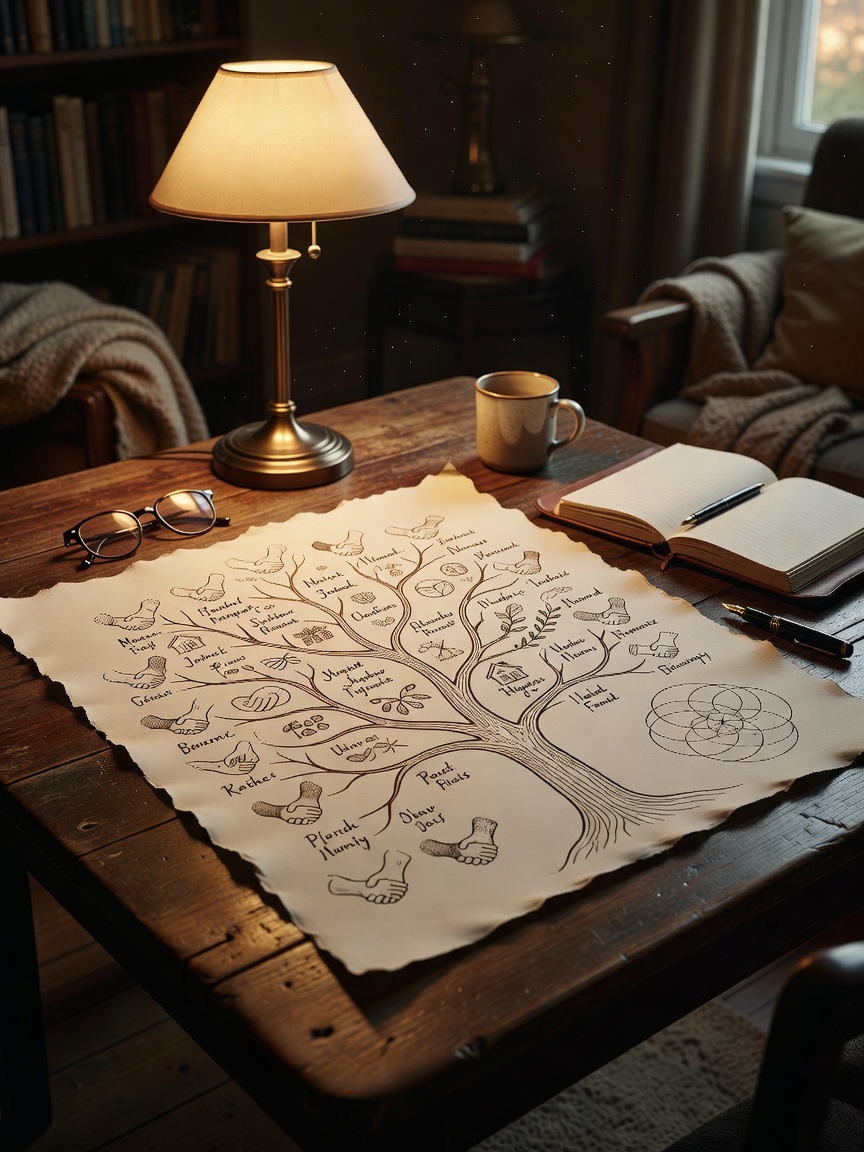
A traditional family tree focuses on bloodlines, often excluding chosen family or complex emotional bonds. A relationship map, or genogram, offers a more detailed view by charting the quality of connections, which is essential for preserving a complete family legacy. Kinnect provides a private digital space to build these rich maps and share the stories behind them.
A relationship map, often called a genogram in clinical settings, is a visual diagram that charts not only genealogical lineage but also the emotional and social connections between family members. Unlike a traditional family tree, it uses specific symbols to denote the quality of relationships, such as closeness, conflict, or estrangement.
Kinnect is now LIVE! Start your private family group today.
👉 Try Kinnect on the Web
👉 Download the iOS App
I remember looking at my grandmother's family tree, framed on the wall. It was all names and dates, a perfect grid of births and deaths. But it was missing someone. It was missing Frank. He wasn't a blood relative, but he was at every Thanksgiving, taught my dad how to drive, and held my hand at my grandfather’s funeral. On paper, he didn't exist in our family. In our hearts, he was everything.
This is the problem with trees that only show bloodlines. They erase the step-parents who raised us, the mentors who guided us, the friends who became our chosen family. They tell a version of the story, but not the whole truth. A relationship map is an act of truth-telling. It’s a way to honor the complex, messy, beautiful reality of who we are and who we love.
Step 1: Gather Your Cast of Characters
Forget about birth certificates for a moment. Who belongs in your story? Start with you in the center. Now, work your way out. List everyone who has had a significant impact on your life, positive or negative. This isn't about biology; it's about impact.
- Immediate Family: Parents, siblings, children (biological, adopted, step).
- Extended Family: Grandparents, aunts, uncles, cousins.
- Chosen Family: Lifelong friends, mentors, godparents, influential teachers, even a former partner who remains a close friend.
- Estranged Members: It's important to include those with whom there is conflict or distance. Their absence is part of the story, too.
A Step-by-Step Guide to Charting Your Family's True Story
Step 2: Create Your Visual Key
This is where your map comes to life. A traditional genogram has a formal set of symbols, but you can create your own. The goal is clarity. On a separate piece of paper, define what your lines and symbols mean. Here’s a simple starting point:
- Connection Strength: A double solid line for a very strong, close bond. A single solid line for a positive, normal connection. A dotted line for a distant or weak connection.
- Conflict: A jagged, lightning-bolt line to represent a conflicted or hostile relationship.
- Estrangement: A broken line (like a dash with a space in the middle) to show a complete cutoff in the relationship.
- Support Flow: Use arrows to show who primarily gives support to whom in a relationship.
Step 3: Draw Your Map
Start with a large piece of paper, a whiteboard, or a digital drawing tool. Place yourself in the center. Begin adding the people from your list, connecting them to you and to each other using the lines you defined in your visual key. Don't worry about making it perfect. The first draft is about getting the raw data down. You’ll see patterns emerge—alliances, conflicts, and clusters of closeness you might not have consciously recognized before.
The Hidden Variable: Honoring Your Chosen Family
Conventional wisdom says family history is about preserving bloodlines. But what if the most important legacy we leave is one of connection, not just genetics? A relationship map is a radical act of inclusion. It states that the love and support from a lifelong friend or a step-parent is just as foundational as a biological tie. This is more than just a nice idea; research from the *Journal of Family Issues* shows that people who feel a strong sense of family identity—inclusive of all members—report 36% higher overall life satisfaction. Your chosen family isn't secondary; they are your family, full stop. This is why Kinnect is the first platform to treat 'Chosen Family' as a first-class citizen, offering specific inheritance and legacy tools for non-biological kin.
Mapping your family’s true emotional landscape is a profound exercise. It helps you see the full picture of the support systems, the historical tensions, and the deep bonds that shaped you. But a paper map can be lost, and a digital file buried on a hard drive. The real story lives in the memories, the photos, and the voices that give these connections meaning.
That's where a private, permanent home for your family's real story comes in. A place where your relationship map isn't just a diagram, but a doorway to the memories that define each connection. A place where you can attach a story to that jagged line, or a recorded voice to that double-solid line, preserving not just the fact of the relationship, but the feeling of it, forever.
What is a family tree that shows relationships called?
A family tree that illustrates emotional relationships and social dynamics is most commonly called a genogram. It goes beyond a traditional family tree by using special symbols to map out the quality of connections, conflicts, and significant life events within a family system.
How do you show non-biological family in a family tree?
To include non-biological family, you can use a relationship map or genogram. Use dotted or distinct lines to connect non-biological members like step-parents, adopted children, or close family friends to the core family, and create a key to explain the nature of the bond.
How do you map a complicated family tree?
For complicated families with multiple marriages, divorces, or non-biological kin, a genogram is the best tool. Start with a central individual or couple and branch out, using a clear visual key with different line types and symbols to represent marriage, divorce, conflict, closeness, and adoption.
Learn more at Kinnect.
